Saturday, October 16, 2010

Fondue

11:45 p.m. Saturday, Oct. 16, 2010 - La Casa, Palenque, Mexico

***

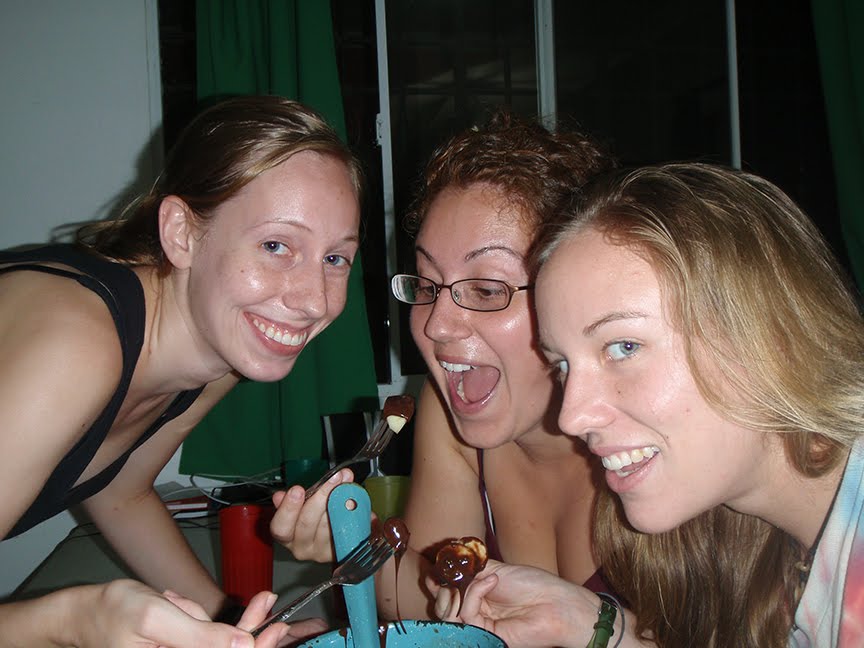
This is what happens when you live in a house with five girls. Tonight on a whim we melted a bunch of chocolate bars and made our own fondue. We dipped in chunks of apple, grape, kiwi and orange and it was INCREDIBLE!


***

Second photo excursion in the jungle

7:18 p.m. Saturday, Oct. 16, 2010 – La Casa, Palenque, Mexico

***

Today our half day turned out to be quite fun; we got the additional data we needed but mainly I was just so pleased to finally have my SLR with me again in the field. It was a lot easier to lug around the gear for only five hours as opposed to the typical ten, and I enjoyed feeling like a real photographer again. It did rain for about an hour in the morning, but I came prepared with my sturdy camera backpack which has a tough outer shell, rain cover and solid straps for carrying in the toughest of environmental conditions. The bag carries all the camera gear I need (Canon 50D w/ grip, 70-200mm f/2.8 L USM, 17-55mm f/2.8 IS USM, 100mm f/2.8 Macro USM, 50mm f/1.8, flash, filters, extra batteries, CF cards) and my computer (though the extra zippered compartment doubles as my hydration bladder storage while I'm in the field). There's even room for my lunch, rain jacket and binoculars in the top compartment. It's a side-loader backpack, which I've come to find essential when photographing on-the-go.

Obviously there are many photos posted on this blog from my daily trips into the forest when I don't have my gear with me, and they are all provided by my previously mentioned water and shock-proof point and shoot. Not exactly the sharpest camera in the shed, but immensely appreciated when I can' t bring my DSLR along for the ride (which is unfortunately often).


***

Wednesday, October 13, 2010

Surviving the fragments

5:30 p.m. Wednesday, Oct. 13, 2010 – La Casa, Palenque, Mexico

***

Monday was the start of my first full cycle with Chiara. Her project has to do with male-male interactions and stress levels in groups living in the national park versus surrounding forest fragments. Therefore, we only really need to focus on monkeys with Y chromosomes. But most of the groups in CBETA (one of the forest fragments) spend a lot of time separated, so we’ll each watch one of the males and switch off to rotate focals. Most of my time working with Chiara is spent searching independently, with us within “woo-ing” distance but split up and exploring a broader range.

Woo Key:

-Woo once: Where are you?/I’m here

-Woo twice: Found the monkeys!

-Woo thrice: Emergency

I have spent a lot of time on my own tramping back and forth between monkeys, creating new paths and following old ones. The result is I already feel like I know my way around CBETA better after three days than I know Palenque National Park (PNP) after ~20 days. While PNP is less dense and has more maintained trails, it is a much more extensive area. Also, since I work with a larger team and am therefore less essential, a side effect is I tend to follow and not pay as much attention to where I am going. In the fragment it is just Chiara and me so I know I’m needed to find the monkeys and collect data/samples. Basically, I have to be on top of my game. I have to learn faster and pay attention to every slight detail of the forest because I’m on my own to get back.

On days when it takes us hours to locate them, I feel all of my senses tensing up and becoming super sensitive. I notice every potential grunt, leaf munch or branch break. I can tell whenever they’ve defecated and urinated in a spot in the past two days, and where they’ve been feeding. The downside to being über aware is a lot of false hope followed by let down. When it’s 11 a.m. and we know we absolutely have to find them in order to complete the six hour daily minimum of focals, every promising sound and movement that turns out to be a bird or squirrel (huge, black squirrels with long tails that look convincingly like howler monkey juveniles) is a heart-breaker.


There are days when I question why I got myself into this mess, mostly having to do with encounters with swarming ants, being caught in prison of thorny lianas and chochos (evil spiky palms who's spines break off in your skin and irritate for days), chiggers in unfortunate places and finding no safe sanctuary in which to answers Nature’s call. A really low moment happened the first day with Griffin, when Chiara and I went through a thick tunnel of vines and came out with our arms and hands covered in swarms of little, red, stinging ants. We got about 20 stings apiece. As you have probably gathered by now, ants are to Peggy as snakes are to Indiana Jones—my only weakness, my Achilles heel and the one thing that can make me scream like a little girl.

Despite all of these constant struggles, most days I return exhausted but satisfied with the work. And the result is I feel like I’m actually cut out for this job. Yesterday we left for the field at 6 a.m. but didn’t find the monkeys until 12 p.m. The two males (Bro and Peter) stayed split for most of the day, but we stilled managed to collect fecal samples from both of them. We didn’t return until after 5 p.m., and then had to enter data and process the fecal material, but we had accomplished it so much and it felt great.

Depending on the day it can be all walking and fighting through thick brush with no chance to sit, eat, think or relax. That was how yesterday was. But the first day with the Griffins was great, with them separate but resting for hours on end. I had time to sit and think, and enjoy other aspects of the forest. When I get the chance I like to photograph or sketch all the critters I see, so I can go back and identify them later. I’m not used to not recognizing the majority of animals I encounter, so the first thing I want to do is figure out what species they are. I have also been using the time spent alone and resting to brainstorm what possible research I would want to do for my PhD. I’ve narrowed it down to dominance hierarchies and mating systems of lemurs, but I should really have a better idea before I start applying for funding.


But either way, resting with the monkeys or traveling with them, the work is definitely heavy. I have been so stressed about applying for graduate school, but working on it any time other than the long breaks has proved to be nearly impossible. All added up our work days are 12-13 hours and by the time we finish we have little time or energy for anything beyond showering and making some food. Tomorrow was supposed to be the first day of the four day break, but Sarie’s group is still missing some data and needs to go back for another half day. I decided to go with them because I felt bad resting while my comrades were working, but I’ll bring all my camera gear to make it worth while.

Today I discovered a new technique--binophotography: photographing through my binoculars. Creates some harsh vignetting, but works much better than I expected.


Pardon the shakiness of the videos, binovideography is taxing on the arms!


***

Sunday, October 10, 2010

Birthday celebrations and Mayan sacrifices

10:05 a.m. Sunday, Oct 10, 2010 – La Casa, Palenque, Mexico

***

We had one more day of Balam—in which they were kind to us and stayed mostly over a pretty little stream. They had and nice, long howling bout and we could track them easily and relax for a change.

Yesterday was also Brittany’s birthday, which worked out perfectly since it was the last day of the cycle and we were able to celebrate in style. After work, Evelyn, Liz and I sneaked off to town to pick up the Rex toy (from Toy Story) we had seen Brittany lust over on several of our grocery trips. It roars when you squeeze it, and to select the perfect one we had a “howling bout” between several to determine the “dominant male” with the most impressive voice. Then Dr. Estrada took us out to dinner at this really fancy restaurant. We took the opportunity to bust out our dresses, which get little use in this line of work.

We all enjoyed dinner and drinks, and joked about things both work and non-work related. It felt nice to hang out with Sarie and Dr. Estrada in a non-work environment for a change. Rex was a big hit, and his roar could be heard often throughout the evening.


After the responsible people headed home, the rest of us headed to El Panchan to continue the celebration. Brittany, Evelyn, Liz and I decided to each order a different cocktail, so we could try something new and rotate around the table. All of ours proved to be pretty typical except for Brittany’s. She had selected the “sacrificio Maya,” and the waiter brought out a double shot mixture of unknown liquors along with a lighter. He began heating the rim of the glass, and when the liquid finally caught fire he instructed Brittany to drink using a straw as he spun the glass and shook cinnamon into the flame. The result was a sweet/bitter rush with a kick of flame and ash at the end which burned the throat. After witnessing the spectacle, we were all impressed and had to order one of our own. It was even better than blowing out birthday candles!


This morning I woke up early and got to work with laundry, house cleaning and graduate school researching. Tomorrow I’ll do a three day cycle with Chiara in the forest fragments in CBETA with the Griffin group. For the time being we are on a system where three of us go with Sarie and one of us rotates with Chiara so she has help monitoring the males for her project. I had been to CBETA on my very first day with Chiara and Jason, but just in one small area so I don’t really know what to expect. I have heard from others that it is a much tougher area that has more dense undergrowth and few trails. So we’ll see how it goes!

***

Friday, October 8, 2010

Photography adventures, deadly caterpillars and Jason's departure

10:10 p.m. Friday, Oct. 8, 2010 – La Casa, Palenque, Mexico

***

It’s been a cycle and a half since I last wrote, but Motiepa—the first group we followed after the four day break—proved to be pretty straight forward and uneventful. The monkeys didn’t give us too much trouble, and we actually found them hanging out right above the road near the trail head. They did eventually move into the forest more, but much of our time was spent sitting on the hot asphalt in the sun, staring up at one of their favorite fruit trees. While working under the dense canopy we are used to the heat and humidity, but not so much the direct sunlight. So our umbrellas served more as parasols than paraguas (Spanish for umbrellas, notice the “for sun” vs. “for water” Latin roots).

Another by-product of standing out on the road was getting approached a lot by locals and tourists. Generally we don’t interact too often with tourists—we hear them from a distance but we spend most of our time off the main paths. Our encounters vary, often resulting in Sarie lecturing them for yelling to get the attention of the monkeys, which obviously disrupts our behavioral study and results in her wrath. But this particular cycle we met several extremely likable groups who were respectful of the forest and its creatures, and sincerely interested about our work.

Over the break we received some bittersweet news, Jason would leaving shortly to go work with another of Dr. Estrada’s graduate students near Playa del Carman for his remaining time here. He’ll be helping the student get started on her study with spider monkeys. While we’re all very jealous that he’ll be living it up on the beach and gaining experience with a different species, we will miss him very much. So on our day off we all went to play cards at his favorite hang out, Mono Blanco in El Panchan.

Next we tackled the Balams, who gave us a good work out and never seemed to rest or settle down like good howler monkeys are supposed to—at least according to the scientists who follow them. Today, day two of the Balams, Sarie gave me the go ahead to bring my DSLR to the field. It’s something I obviously have been planning to do ever since I got here, but have been very apprehensive for several reasons. For one, it is very dear to my heart and wallet and the forest is not a forgiving place. It normally rains at least a little everyday, and often downpours. Also the gear is not light, and would be a huge burden on top of all my other gear. Plus, I’m here to work. While the occasional snap shot with a point and shoot is not that disruptive, busting out my DSLR and assorted lenses is a little more time consuming and distracting. I tend to go in “the zone” as a photographer, and I was worried about trying to multitask and juggle my more important responsibility as a behavioral researcher. But the weather has been unusually dry and clear, so I decided to take the chance while I still could.

Unfortunately it was my day to perform the scans, which is generally the most time consuming of the duties because it entails taking the GPS coordinates and recoding the behaviors of all the individuals every 15 minutes. So I got a little stressed out trying to follow the monkeys with a heavy backpack, and take photos while still being productive and keeping tabs on everyone. The Balams took us to a remote area with a lot of crumbling Mayan foundations, a pain to walk on but fascinating to examine.


While the monkeys didn’t come down as low as I had hoped, I still managed to get a few decent shots. But when they’re residing at the top of the canopy with the sun directly behind them, they are reduced to mere silhouettes in my viewfinder. It rained for a bit, but I brought a sturdy camera backpack with a good rain cover so my gear was pretty well-protected.


However, my camera proved to be more useful for things a little more at our level. Towards the end of the work day we were clustered under a tree, staring up at the monkeys and straining our necks per usual. I reached in front of me to grab a thick liana (wooded vine) to hold onto for support. The instant I tightened my grip around the vine I experienced intense pain and shock, and I pulled back my hand to reveal a green and purple, heavily armed caterpillar on the other side of the liana. Yes, I realize a caterpillar hardly sounds dangerous, but this guy packed a powerful punch. The potent burning sensation in my finger didn’t subside, but rather steadily increased until my whole hand felt like it was on fire. I could see angry welts developing at each of the six contact points my index finger had with one of the stinging barbs. And while my finger began to swell and throb, my thoughts had shifted urgently in another direction.

“Must grab my camera!” I switched from telephoto to macro, and set up shot after shot of the decorative insect while it stood perfectly still—understandably unafraid of anything. The sting was definitely one of the most painful I’ve ever experienced, but having it occur on the one day I brought my camera (and macro lens to boot) made the pain more than worthwhile. Call me a masochist, but I came out of the experience totally pleased with the results (and at least the sting was on my non-shutter finger).


Today was Jason’s departure day so we all made a group dinner and shared a toast in his honor—wishing him luck on his new adventure.

***

Saturday, October 2, 2010

Weather and wisdom

9:55 p.m. Saturday, Oct. 2, 2010 – La Casa, Palenque, Mexico

***

While the change in seasons here are nothing like my beloved North Carolina, I'm still noticing distinct differences besides the massive increase in precipitation. The average daily temperature has dropped about ten degrees since I first arrived (closer to 20 at night), and when it's not raining the weather is quite pleasant and not so unbearably hot. I’ve even busted out jeans on a few occasions. The cold showers have become more of a daily nuisance rather than a daily six minutes of bliss, and I now completely utilize my one, thin sheet rather than kicking it off early in the night.

Some things I’ve learned/am still getting used to:

1) Change is extremely difficult to hold on to, but is also necessary for survival here. You can’t break anything over a $50 peso bill on the street (~$5 USD) and often not even that. Unfortunately, the ATM usually spits out $200 MXN bills in your hand (sounds like a lot but is less than $20 USD), so trying to break them is a constant mission. If you were dropped off around here with only a $200 bill you would probably starve. Also, dealing with the bill (la cuenta) at a restaurant is always a huge ordeal. They only provide the total for the entire group—usually scribbled in pen on a napkin—so it always takes us a while to figure out who owes what and how much with tip.

2) My understanding (or lack thereof) of the Mexican postal system can best be illustrated by the following email to my good friend Liz:

Dearest Liz,

Please send me your address. That does not mean you will get any mail necessarily, I'll leave that in the hands of the Mexican postal system which are perhaps the worst hands a piece of mail can be in. I don't even have an address here (just some vague directions to an unnumbered house on an unnamed road), and the whole town of Palenque seems to be out of postage stamps. I've heard that letters/packages can take months to deliver--if at all. And yet all the vendors still sell postcards to the tourists! Figures.

On second thought, I will place my message in a bottle for you and send it adrift and hope that it floats up the Atlantic Gulf Stream, is blown into the Charles by a Nor'easter, picked up by a homeless woman, eaten, pooped out on the street, swept up into a trash can, dumped into a garbage truck, driven by the truck to your apartment, dropped out on the street, picked up by the mail man, and delivered into your mail box. Because THAT will happen faster and more reliably than Mexican post.

So, you should definitely be holding your breath. That is, if you have a lung capacity 86400x that of the harbor porpoise.

3) I find myself dreaming more than is healthy about howler monkeys; I’m starting to have a reoccurring one where I panic because I can’t find them.

4) My body is perpetually itching and covered in bug bites.

5) I’m still trying to find ways to get ahead of the ants that infiltrate our kitchen daily. My latest struggle has been over my jar of Nutella (a delicious hazelnut/chocolate spread similar to peanut butter, for those who are unfortunate to have never tried it). I discovered quickly that ants can even find their way into a tightly screwed jar. So I started putting my peanut butter and Nutella in the fridge, which works fine for peanut butter. But the Nutella does not fare well in cold temperatures, and became so hard that I couldn’t even stick a knife in it. I tried to microwave it or a few seconds, but didn’t realize there was still a tiny bit of foil left around the rim. The microwave quickly notified me of this by flashing bright white and sparking. After nearly setting our kitchen on fire, I decided to try a different approach. I took a bowl of water and rested the jar in the middle of it. I now had a nice mote protecting my Nutella. After a week my jar remains untouched, but ants are not above committing suicide in attempts to cross the water. Their bodies float around the bowl, testament to their foolish devotion to the queen, but none have managed to successfully cross the liquid barrier. Yet.

Adjustment is hard, but sometimes all it takes is a bowl of water.

***

Thursday, September 30, 2010

Agua Chocolate

8:22 p.m. Thursday, Sept. 30, 2010 – La Casa, Palenque, Mexico

***

I finally got my stitches out, with a stern lecture from el doctor scolding me for keeping them in for eleven days rather than the prescribed seven. He just said my punishment would be it hurting more as the skin had partially healed over the stitches. When I road up to the park entrance to meet up with the rest of the group, I called Sarie to let her know I had arrived so she could hike out and get me (I had no idea where they would be in the forest since we hadn't tracked the monkeys the day before). However, I couldn't get through due to a lack of service on her side, so I just dozed off in the parking lot for an hour and a half until she finally got out of the dead zone. The other assistants and I survived the final two days of Pakal observation with the knowledge that we would have a nice, four day break ahead of us. The powers that be had business elsewhere that would keep them out of the field, and also recognized that we needed some time off.

Evelyn, Liz, Brittany and I decided to stay close to home for this break, as we all have been stressing out about applying for PhD programs. Most of the deadlines are the beginning of December, so we have loads to do before then. I have schools to research, potential advisers to email, recommendation letters to request, transcripts to send and statements of purpose to write.

Today, day two of the break, we did allow ourselves to take an afternoon trip to Agua Azul, some cascades about an hour away. We had a little trouble finding a ride at first, but finally hailed what I can best describe as a truck with a trailer in the back for transporting people. Not quite a colectivo, but still a common resort for getting from point A to point B. The last time we had ridden in one was on the way back from Misol-ha, which was a windy but enjoyable ride. The trailer had been covered on the top and sides, but not front and back—allowing for sufficient ventilation. This trip, which was twice as long at an hour and a half, was much more miserable. The bed of the truck was covered on all sides but the back, where the exhaust pipe was. So our quarters were quickly filled with fumes which stayed with us for the duration of the journey.

The road was long and winding, through the hills and around hairpin turns. Motion + fumes = 4 not so happy riders. Our perky conversation turned to silence about a third into the trip. When we finally arrived it was almost 4 p.m. We recovered our land legs and walked around the park, which consisted of magnificent cascades which seemed to go on forever. We would take pictures and admire one level, then go up the stairs to see the next…on and on for about six levels. While the area is known for its sparkling, clear-blue water, the past two weeks of solid rain coupled with the recent mud slides due to Tropical Storm Matthew have transformed Agua Azul into Agua Chocolate. But we enjoyed walking around and climbing trees until the park closed.


We once again struggled to find a ride back, finding from most drivers that they usually carry people from Palenque to Agua Azul but not back. Great system. Since we got burned last time we arranged ahead of time for a driver to come pick us up, we decided to wing it today. Luckily, we were able to talk one of the people-trailer drivers into taking us back for 60 pesos. This time we squeezed into the cab up front and our lungs were thankful.

When we got back to Palenque, we still needed a ride back to the house but it was after 6 p.m., when most colectivos stop running (taxis still run but are more expensive). While we were waiting, a man who was going to be taking some workers home asked where we were going, and said he could give us a ride. However, he turned down the left fork instead of the right and took us a few kilometers the wrong way. We finally shouted up to the front for him to drop us off, and none of us paid as we were even farther from home. A colectivo came our way and took us back to Palenque, but no more passed going towards our house. So, in keeping with our transportation woes, we walked all the way home.

***

Sunday, September 26, 2010

Barriers of words and water

11:00 p.m. Sunday, Sept. 26, 2010 – La Casa, Palenque, Mexico

***

Today was a rest day rather than a work day—as scheduled. It was a sunny day rather than a stormy day—as predicted. This was bad news rather than good news—as expected.

Let me explain. Thursday we set out on the first day of our third cycle, charged with finding and observing the Pakal group. I’d heard many stories about this group, because it has two extremely lively juveniles (Kanika and Emma) who like to come close and cause trouble. It is usually hardest to find a group on the first day, because they could be anywhere within their territory. It often takes two to three hours of searching before we find them. But 9 a.m. came, and no Pakal. We found Balam, and heard several groups howling in the distance, but no Pakal. Noon came, still no monkeys. 3:30, nothing. At this point it began to rain heavily and if we hadn’t found them yet, we sure wouldn’t in a downpour. So we headed out.

Though it was certainly an unsuccessful day, our spirits had somehow remained high throughout the day and the four of us and Sarie had good conversation while circling the territory hour after hour. I also enjoy hiking for the sake a of hiking, so after a while started to feel like I was on a day hike in the rain forest with no other purpose than to enjoy the sights and sounds of the jungle. My legs and feet were sorer than usual, but we would try again the next day and all would be well.

That is, until we were informed yesterday that a day without usable data does not count as a work day, and we would have to make it up on one of our rest days. Therefore, yesterday we went into the forest even more desperate to find Pakal, with added motivation. We couldn’t stand the thought of losing two rest days searching in vain. Luckily, we found them around 10:30 a.m. and collectively sighed in relief. It started to rain around noon, and we all (monkeys included) hunkered down to attempt to stay dry while still collecting observational data. It rained for pretty much the rest of the afternoon. “Peggy, I’d like you to meet Rainy Season in the rain forest, Rainy Season, meet Peggy.” While I had grown somewhat accustomed in the few weeks I’d been here to nightly downpours and just the occasional daytime rain, it now seems like the rain is coming sooner and sooner everyday.

We had three straight field days where the sky opened up just before we completed our last scan; therefore, our return trip was always a wet one. But for the past few days the rain has been taking bigger chunks out of our day. What was thick mud in the morning becomes a deep, raging brown river by afternoon. The hills become deadly mudslides requiring a vine as a rope to rappel ourselves down. It’s difficult to recognize where I am because the trails I remember from the morning are transformed into streams. And somehow we have to get all our gear dry overnight and be ready to do it all over again the next day.

But yesterday evening Dr. Estrada emailed and said we wouldn’t be going into the field today because Tropical Storm Matthew would be dumping on some additional wind and rain (although it ended up being sunny most of the day), and the data probably wouldn’t be that good anyway (in addition to it not being very safe to be in the forest during a topical storm). Unfortunately for us, this would most likely take another day from our long anticipated break. We still hadn’t finished the Pakals, and would have to go back to the field two more days before getting some time off.

Last night, after finding out we wouldn't be working today, the household (plus Katie and Chiara's two visiting friends) went to Don Muchos in El Panchan for dinner. The community of El Panchan is set up around a little river, with walkways and bridges crisscrossing around the perimeter. We left that evening still in a relentless downpour, and walked down the road until we got picked up by a taxi. When the driver dropped us off, he had to do so at the edge of the street because the parking lot was so full of water. We started to take the path through the woods to the restaurant, but couldn’t even see the wooden bridge over the river because it was covered by rushing water. With only one light between all of us, we had to inch our way along the invisible path. We cautiously traversed the narrow bridge covered with two feet of water, knowing if we stepped to the left or the right we would drop off completely into the river. But we proved our worth, and took a leap of faith off the lion’s head like Indiana Jones. When we stepped down from the bridge, we still had 20 meters left to wade in water up to our waists before we finally arrived, drenched but alive, to the restaurant. We made the trip worth while by eating delicious Italian-Mexican pizzas and staying for the fire spinning show.


Today I attempted to get my stitches removed at the local hospital clinic. Last time I had Katie with me to translate, but I figured I would be all right on my own to just get them removed. I made sure to look up the words “remove” and “stitches” en Español (“quitar” y “puntos”) and headed to town. I waited at the front desk until a man came to help me. I said in broken Spanish what I needed and he kept shaking his head, saying what I thought to be tomorrow at 8:11. I was thinking, “Why 8:11 tomorrow?” I asked him why not now, and he kept shaking his head. There were people all around me waiting so I didn’t think it was closed (though it was Sunday), but didn’t know how to get any more detailed of an answer with my limited vocabulary. I told him I had to work tomorrow but he just shrugged. This was the first real problem I had experienced with a language barrier since I had arrived. My other experiences speaking Spanish (or trying) have just been attempts at friendly conversation, in the market or in a taxi. All of which have much less at stake. It was so frustrating needing something but not getting it, and not understanding why.

The experience reminded me of my court date in Raleigh last year for a speeding ticket. While I was waiting for the judge to call me up, I saw all of the other would-be law-breakers speak to him about their crimes. Most were there for speeding, like me, petty theft or possession. But one couple went up to the front, looking scared and utterly bewildered. It was a Mexican man and his wife. From what I could overhear, they had been caught fishing at a river near their home without a fishing license. I can only imagine how confused they must have been to be summoned to court and fined just for fishing. I watched and listened as the man tried to explain to his crying wife what was happening. But I could tell he didn’t understand much of what the judge was saying either. I wanted to jump up and shake the judge and say, “Really? Don’t you have better things to do than take money from these people?!” But I remained silent and seated at my bench.

Tonight I went to see Jason play a set at Mono Blanco and then followed the Red Sox vs. Yankees game as best as I could via ESPN GameCast. The Sox failed to sweep the Yankees, shrinking their playoff chances to less than the area of a pinhead. As in, they would have to win their next seven games (three of which are against New York again) and the Yankees or Rays would have to lose all of theirs for the Red Sox to have a postseason.

Tomorrow I will try my chances again at the hospital (I figured out later the man probably meant the doctor would only be in 8-11 a.m. tomorrow) and then join the others in the field.

***